
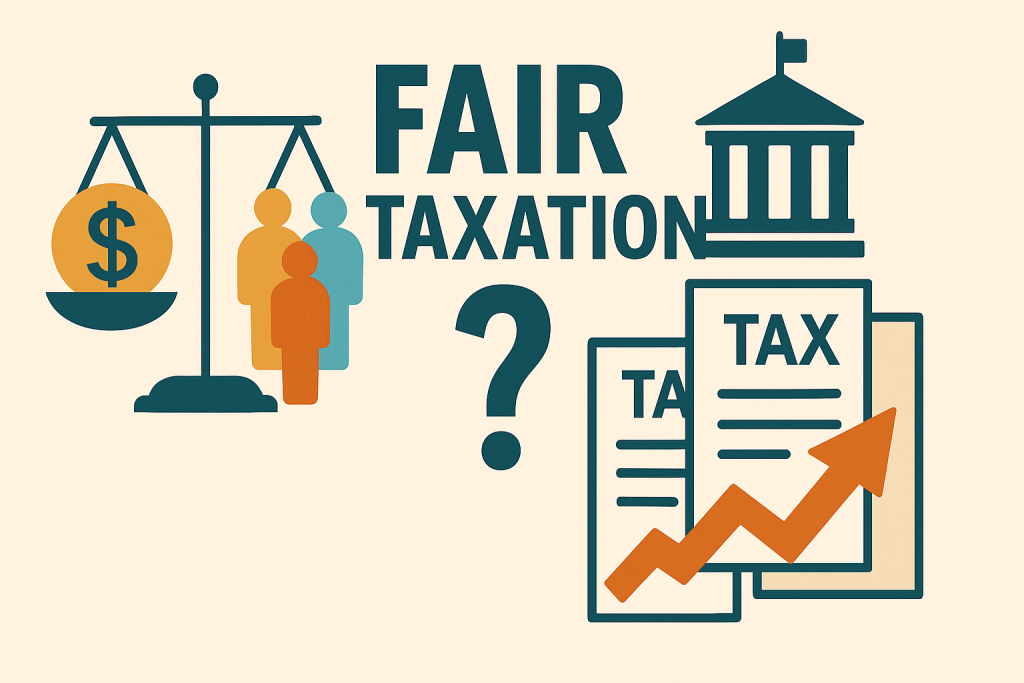
What Do We Mean by “Fair Taxation”?
Australia has developed a curious political reflex: almost everyone demands better hospitals, better aged care, better schools, better roads, better wages for nurses and teachers, ie they just want ‘more’—but the moment the word tax is mentioned, the temperature in the room drops. Calls for additional revenue are seen as politically dangerous, even though expectations of public services continue to rise. How did we get here? And what do we mean when we say a tax system should be fair?
The first challenge is conceptual. “Fairness” in taxation is not a single idea—it is a bundle of competing principles: ability to pay, proportionality, equity, efficiency and the legitimacy of what the revenue is used for. We often argue passionately about tax rates without ever unpacking which of these principles we are appealing to.
Australia’s Tax Culture Shifted in the 1990’s.
Australia’s increasingly anti-tax mindset did not emerge accidentally. During the Howard era, the introduction of the Goods and Services Tax (GST) was framed as “modernising” the tax system, i.e. a ‘good’ thing supposedly. The GST is, however, unambiguously regressive: people on lower incomes spend a larger proportion of their earnings on consumption, and so they pay a larger share of their income in GST.
Economists promoting the GST often relied on arguments about efficiency, not fairness. The idea was that a broad-based consumption tax distorts behaviour less than taxes on income or corporate profits. But this “efficiency” claim only really holds if the GST is applied evenly across all goods and services—something Australia’s system does not do. Basic food, healthcare, and education were exempted to make the tax more palatable but most people need cars, petrol or diesel, electricity, gas, and entertainment such as going to the cinema or having some beer or wine. These are not really luxury items but the necessities to enjoy life. However, there is no GST on property or company shares, only on the services used to buy these.
The top personal income tax rates are now at 45% compared to essentially 95% in 1945. Thus those with incomes over $200,000pa now have funds to buy real estate and, as a result, inequality has grown dramatically. In the 1950s, people could expect to buy their home, with a mortgage costing no more than 30% of their income. Now, people in capital cities are often having to pay up to 60%.
The result is, in effect, a tax that is neither uniform nor fair, yet politically entrenched.
Over the last 50 years, top rates of income tax were repeatedly reduced, and bracket creep became a central (but invisible) way of shifting the tax burden downwards. Over several decades, the system has quietly become far less progressive.
The reduction of income tax on high incomes is sometimes referred to as the great ‘flattening’. This can be seen in a simple graph of marginal tax rates against income every 15 years from 1950 to 2025. The change is also sometimes described as a move from progressive to incentive taxation, though those with very high incomes have been the greatest winners.
At the same time, wealthy households have benefited from capital gains discounts, superannuation concessions, negative gearing, and trust structures—features that overwhelmingly benefit the top 10%, not the average worker. While the Australian tax system remains ‘nominally progressive‘, it has become increasingly less progressive over the last 80 years.
But is fairness only about rates? Or is it also about what tax Is spent on, what it is used to Pay For?
Some people define fairness purely in terms of what each person pays—how much tax individuals owe, and whether the wealthy should contribute more. But fairness can also be assessed in terms of what tax allows us to do: schools, hospitals, aged care, disability services, disaster response, scientific research, the transition to renewable energy, social housing, public transport.
If a tax system raises too little revenue, even if it is “efficient,” it may still be unfair—because it cannot meet society’s needs, or because the shortfall is filled by cutting services that disproportionately harm those with the least.
What Should Count in a Fair Tax System?
There are a number of issues that any discussion of fair taxation must wrestle with:
Firstly there’s the Ability to Pay
Should those with greater wealth and income contribute proportionally more? This has been the foundation of progressive taxation for over a century. An extra $100 of income means a lot more to a person earning only $500 a week than to a person earning $10,000 a week.
Secndly there’s the Cost of Living and Basic Needs
A flat tax may look “equal” but can be deeply unfair. The first $30,000 per annum of income means something different to a pensioner than to a banking CEO. Middle income people with families and mortgages or high rents tend to have very little discretionary income.
Is our current Mix between Regressive vs Progressive Taxes acceptable?
Australia relies heavily on regressive taxes such as the GST, fuel excise, insurance levies, state stamp duties. Should the balance shift?
Is the mix between Corporate versus Personal taxation correct?
Much wealth now comes from assets, not wages. A fair system may need to tax capital gains, superannuation concessions, and multinational profits more effectively.
Transparency and Legitimacy is also important.
People tolerate taxes when they believe:
- that revenue is spent fairly,
- that government services work,
- that corruption is minimal, and
- that tax avoidance is well policed.
Without trust, even fair taxes feel unfair.
Another issue raised more and more these days is the question of Intergenerational Fairness
Under-taxation today can become a burden on younger generations through poorer public services or higher debt to be repaid in the future. Is that fair? Should future generations have to pay for our excesses now?
Finally, it is worth mentioning the question of Environmental and Social Purpose
Should tax systems reflect environmental costs (carbon pricing) or equity objectives (reducing inequality)?
Or should taxation remain value-neutral?
So, What Is a Fair Rate of Taxation?
There may be no simple answer. However, several broad principles might guide a fairer approach:
- Those with more should contribute more. This is not envy; it is recognition of unequal capacity to pay and unequal benefits received from the economic system.
- Taxes should not push low-income households into hardship.
- Should the system raise enough revenue to fund the services society collectively demands or should it just print more money! The costs of those services that require person to person consultation, such as hospitals and medical specialists, have risen steeply, as have the costs of new treatments covering more and more conditions. To pay for these, shouldn’t the Australian government raise more tax?
- The overall tax mix should reduce inequality, not amplify it
- Currently the ATO generally taxes only flows of funds not stocks. Should we consider wealth or inheritance taxes?
- The purpose of taxing matters as much as the rate. What proportions of revenue should be put to defence or law enforcement. Most people do not know what these proportions are and, furthermore, they do not know what they think they should be. Last year, Australian defence spending was approximately 2.0% of GDP (roughly $56–59 billion). The government is actively increasing this funding to over 2.3% of GDP by 2033–34. This rate has remained relatively stable around 1.9–2.0% for several years, though some have called for it to reach 3% given the current world security situation.
Australian’s strange resistance to discussing tax revenues openly and honestly makes it harder to have a meaningful conversation about how we fund the society we say we want.
Here is the key question for you to ponder –
If fairness is to be more than just numbers on a tax table—if it is about equity, shared responsibility, and the society we wish to build—then:
What principles do you think should define a fair taxation system in Australia today?
Is fairness about contribution? About outcomes? About opportunity?
Or about something deeper?
Possibly all Australians would be interested to hear what other Australians think about this, i.e. not just supposed experts and politicians.. So, as we say, please “Join the Discussion”.