
Summary
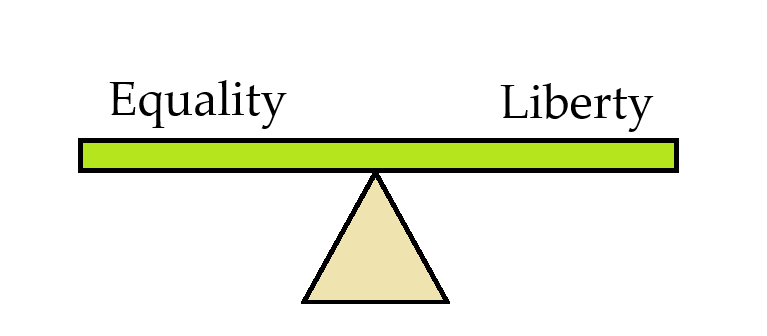
The living balance, between freedom and equality, sometimes referred to as Equaliberty, combines together the two foundations of democracy that can never be separated. True liberty loses meaning when it becomes the privilege of the few, and equality becomes oppression when it denies personal freedom. From the early days of Australian democracy to global challenges today, every struggle for justice and inclusion has been a step toward realising equaliberty — the promise that all people can be equally free.
This principle lies at the heart of the Universal Fellowship, which seeks to make equaliberty a guiding reality in public life — across nations, cultures, and generations.
Equaliberty — The Living Balance of Freedom and Equality
The idea of Equaliberty brings together two of the deepest human aspirations — freedom and equality — and reminds us that neither can survive without the other. The term was coined by the French philosopher Étienne Balibar, who argued that these two principles are “co-original and inseparable” (Balibar, Equaliberty: Political Essays, Duke University Press, 2014). In other words, true freedom can exist only where people are equal, and true equality can exist only where people are free.
Balibar drew inspiration from the ideals of the French Revolution, with its call for liberté, égalité, fraternité, and from the long traditions of both liberal and socialist thought. But his insight was that modern societies often treat liberty and equality as if they were in conflict. Liberals emphasise freedom — especially freedom from government interference — while social democrats and socialists emphasise equality and fairness. Balibar’s point is that if we separate them, both collapse. Freedom without equality becomes privilege — the liberty of the few. Equality without freedom becomes control — the uniformity of compulsion.
Democracy, then, is not a finished state but a living process — a continual effort to balance liberty and equality so that each supports the other. This tension is not a flaw; it is the essence of democratic life.
Equaliberty in Australian Democracy
Australia’s democracy provides a vivid example of this ongoing negotiation between freedom and equality. From its beginnings, the nation combined a strong liberal tradition of individual rights with a distinctive egalitarian culture expressed through institutions like compulsory voting, public education, and a universal health system.
Each of the major political traditions reflects a different emphasis within the equaliberty balance:
- The Liberal Party has historically stressed individual freedom, enterprise, and limited government — the liberty side of the equation.
- The Australian Labor Party (ALP) grew out of the workers’ movement, focusing on collective action and fair distribution — the equality side.
- The National Party represents rural and regional interests, where liberty means local self-reliance but equality requires fair access to services and markets.
- The Greens bring a newer dimension, linking equaliberty to environmental justice and the rights of future generations, insisting that true freedom also means freedom from ecological collapse.
Across these differences, Australian politics can be seen as an ongoing conversation between liberty and equality, sometimes harmonious, often tense. Key achievements — such as women’s suffrage, the minimum wage, Medicare, and Indigenous recognition — mark moments when the democratic balance shifted toward a fuller realisation of equaliberty. At other times, inequality or exclusion — from the White Australia Policy to current refugee detentions — have shown how fragile that balance remains.
As political theorist Marian Sawer notes, Australia’s egalitarian impulse has always coexisted with a belief in personal independence; the nation’s political culture “combines equality of respect with liberty of action” (Sawer, 2003). That blend, imperfect though it is, continues to define what Australians mean by a “fair go.”
Equaliberty and the Universal Fellowship Vision
The principle of equaliberty extends beyond national borders. Balibar insists it must be universal, because if liberty and equality are rights for anyone, they must be rights for everyone. In a world divided by wealth, nationality, and ideology, equaliberty calls for new ways of thinking about democracy — not just as government within a nation, but as shared responsibility among all people.
This idea lies at the heart of the Universal Fellowship project. The Fellowship’s purpose is to explore and promote the conditions under which liberty and equality can truly coexist — across nations, cultures, and beliefs. It seeks not only to defend these values in theory but to model them in practice, through transparent governance, shared participation, and inclusive dialogue. Its guiding belief is simple:
Freedom without equality is privilege. Equality without freedom is control. Equaliberty is their living balance — the heart of democracy.
In this sense, the Universal Fellowship is a living expression of Balibar’s insight. It stands for the possibility of a world where equality and liberty grow together — where every person is empowered, and every community is treated with dignity. Equaliberty, then, is not only a philosophical concept but a moral compass for the future of democracy itself.
What do you think?
Is inequality getting out of hand? Are liberties constantly being reduced by increasing rules at both the local and government level? How can one define a balance between the two?
References
- Balibar, Étienne. Equaliberty: Political Essays. Duke University Press, 2014.
- Balibar, Étienne. Citizenship. Polity Press, 2015.
- Rancière, Jacques. Disagreement: Politics and Philosophy. University of Minnesota Press, 1999.
- Arendt, Hannah. On Revolution. Penguin Classics, 2006 [original 1963].
- Sawer, Marian. “Australia and the Logic of Equality.” Democratic Audit of Australia, Australian National University, 2003.
- Stokes, Geoffrey. “Australian Democracy and the Paradox of Egalitarian Liberty.” Australian Journal of Politics and History, 49(1), 2003.